You’ve crafted the perfect email. The copy is crisp, the design is beautiful, and the offer is compelling. You hit “send,” but the results are… just okay. Your open rates are flat, and your click-through rate is stagnant. Sound familiar?
The hard truth is, what we think will work often isn’t what our audience actually responds to.
This is where email ab testing (also known as split testing) comes in. It’s the single most powerful method to move from guesswork to data-driven decisions in your ab testing email marketing strategy. It’s the difference between hoping for results and knowing how to get them.
But to test effectively, you need the right tools. It can feel overwhelming to know where to start. In this guide, we’re breaking down the top email testing tools on the market. We’ll compare their features, strengths, and who they’re best for, so you can choose the right one to start improving your metrics today.
Table of contents:
- What is email A/B testing and what should you test?
- The “why”: the critical elements to test for higher engagement
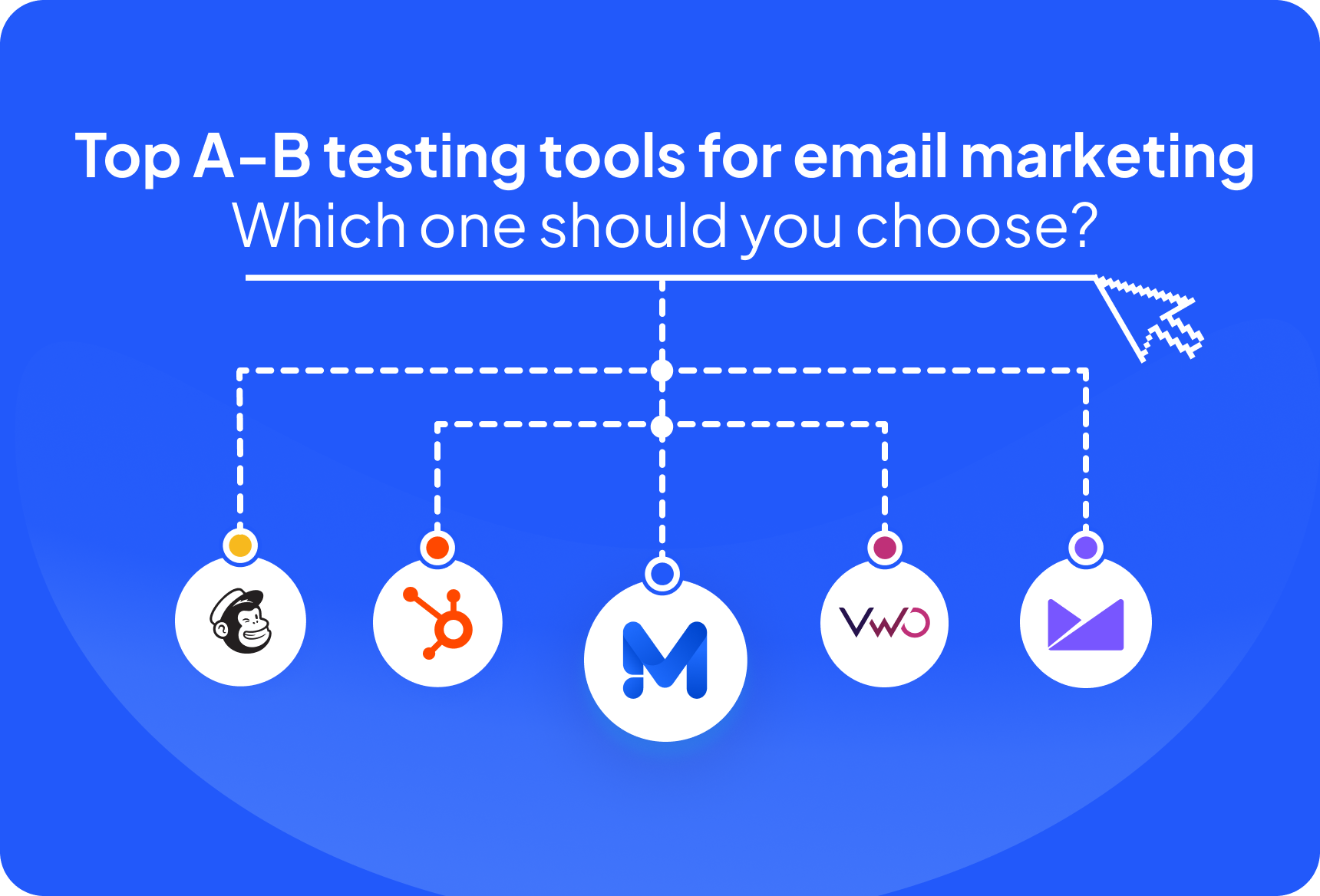
- The top 5 email A/B testing tools for 2025
- How to choose the right tool for you
What is email A/B testing and what should you test?
At its core, email A/B testing is a simple but powerful method. You create two variations of a single email—let’s call them Variation A and Variation B. You send Variation A to a small subset of your audience and Variation B to another small, random subset.
The variation that performs better (e.g., gets more opens or clicks) is then declared the “winner” and sent to the rest of your audience. It’s real-time, data-driven feedback from the people who matter most: your subscribers.
The “why”: the critical elements to test for higher engagement
You don’t need to test everything at once. In fact, you shouldn’t. The best practice is to test one variable at a time to know exactly what caused the change. This is where you’ll find the biggest wins.
- A/B testing subject lines: This is the big one. Your subject line is the front door to your email. No matter how good your content is, it won’t be seen if the subject line doesn’t work. It’s no surprise that so many marketers are specifically looking for a reliable email subject line tester.
- Sender name: Would your audience rather hear from “Andrei at theMarketer” or “theMarketer Team”? Testing this can have a major impact on trust and open rates.
- Call-to-action (CTA): Test the copy (‘Get Started’ vs. ‘Try for Free’), the color of the button, or even its placement. This directly impacts your click-through and conversion rates.
- Email content & design: Does a short, text-only email perform better than a visual, HTML-heavy one? Should you use a different hero image? These tests help you understand what your audience wants to see.
- Send time/day: A classic test. You might find that your B2B audience responds at 9 AM on a Tuesday, while your B2C list is most active at 8 PM on a Thursday. Only testing will tell you.

The top 5 email A/B testing tools for 2025
To give you a fair comparison, we’re not just looking at one feature. We’re evaluating these tools based on a few key criteria to find the best email testing tools:
- Ease of use: how simple is it to set up and run a test?
- Integration: is A/B testing a core part of the platform, or is it a clunky add-on?
- Reporting: how clear and actionable are the results?
- Automation: can the tool automatically send the winning version?
1. theMarketer
Best for: Small to medium-sized businesses and marketing teams who want powerful, integrated A/B testing without the complexity.
Key A/B testing features: We’ve designed theMarketer’s email ab testing capabilities to be a seamless part of your campaign workflow. You can easily test subject lines, sender names, content, and send times right from the campaign builder. Our platform is built to make you smarter, faster.
A key feature is our ‘set it and forget it’ automation. You can tell the system to test on a 20% portion of your list for 4 hours, and it will automatically send the winning variation to the remaining 80%. No need to log back in and manually send.
Our perspective: We believe A/B testing shouldn’t be a feature reserved for data scientists. It should be an intuitive, everyday tool for marketers. While some tools treat testing as an afterthought, we’ve built it into the core of our platform. You get the power of enterprise-level testing with the simplicity and clear reporting that our users love, allowing you to focus on results, not on figuring out the software.
▶️Why just read about boosting conversions when you can see it in action? Book a free platform tour with one of our specialists today.
2. Mailchimp
Best for: Beginners, bloggers, and solopreneurs who need simple, straightforward split testing.
Key A/B testing features: Mailchimp is one of the most well-known names in email, and their mailchimp split testing feature (as they call it) is a core part of their offering. They allow testing for subject lines, sender names, content, and send times. It’s accessible and easy to understand for those new to email marketing.
Our perspective: Mailchimp is a fantastic starting point for testing. It’s built to be user-friendly and gets the basic job done. As your segmentation and automation needs become more advanced, however, you may find you want more granular control over your tests or deeper reporting that connects to a larger marketing picture.
3. HubSpot
Best for: B2B companies and sales teams who need A/B testing deeply integrated with a powerful CRM.
Key A/B testing features: HubSpot’s email ab testing is powerful because it connects directly to its entire ecosystem. You can not only test for opens and clicks but also for how many leads or demo signups each email variation generated. This is ‘full-funnel’ testing, and it’s very powerful.
Our perspective: HubSpot is an undeniable powerhouse, especially if your entire business already runs on their platform. The trade-off, however, is often cost and complexity. The A/B testing feature is part of their ‘Professional’ tier, which can be a significant investment. It may be more firepower (and budget) than a growing business needs just for email optimization.
4. Campaign Monitor
Best for: Design-focused teams and agencies who value beautiful templates and clear visual reporting.
Key A/B testing features: Campaign Monitor has always excelled in the visual department. Their email testing tools make it simple to test different templates and designs, and their reporting provides a clear, visual breakdown of what worked and why. It’s very intuitive.
Our perspective: This is a great choice for brands where aesthetics are paramount. Their approach is extremely user-friendly, which aligns with our own philosophy at theMarketer. It’s a solid, reliable platform for marketers who prioritize visual design and straightforward reporting.
5. VWO (Visual Website Optimizer)
Best for: Advanced marketing teams and dedicated optimization specialists who want to run complex, multivariate tests.
Key A/B testing features: While VWO is famous for website optimization, its platform also extends to ab testing email marketing. This is for teams who want to go beyond simple A/B tests and delve into multivariate testing (e.g., testing 3 subject lines and 2 CTAs simultaneously). It’s a true data-science tool.
Our perspective: This is a highly specialized, high-power tool. It’s less of an all-in-one email marketing platform and more of a pure-play testing suite. If you have a dedicated optimization team, VWO is a top contender, but it’s not the right fit for a marketer who needs to build, send, and test campaigns all in one place.

How to choose the right tool for you
The ‘best’ tool is the one that fits your specific needs, budget, and workflow.
- If you’re just starting out… a tool like Mailchimp offers an easy entry point.
- If your entire business runs on a CRM… HubSpot offers deep, (but costly) integration.
- If you are a dedicated data scientist… VWO provides complex multivariate options.
But if you’re like most marketers, you need the perfect balance. You need a platform that is simple enough to use every day but powerful enough to provide real, actionable insights.
This is exactly why we built theMarketer. It gives you the advanced optimization features you need, without the complex overhead, letting you focus on results.
Ultimately, email ab testing is not optional anymore—it’s the foundation of a successful email strategy. The tools above all offer ways to get started, but the most effective tool is the one you’ll actually use.
We believe that should be easy, intuitive, and effective. See for yourself how theMarketer’s built-in A/B testing can improve your open rates and drive more conversions.
Photo source: www.freepik.com
Frequently asked questions (FAQ)
What is the most important element to A/B test in an email?
While you can test many things, the most impactful element is almost always the subject line. We see marketers constantly searching for the best email subject line tester because ab testing subject lines directly influences your open rate—the first and most important metric.
What’s the difference between A/B testing and split testing?
For most marketers, the terms are used interchangeably. Both refer to testing a Variation A against a Variation B. ‘Split testing’ is the term Mailchimp often uses (which is why mailchimp split testing is a common search) , but it means the same as email ab testing.
How long should I run an e-mail AB testing?
A great question. You need to wait for ‘statistical significance.’ Most platforms, including theMarketer, will automatically determine a winner after a set period (e.g., 4-6 hours) or once a sufficient number of responses have come in. You want to wait long enough to get reliable data, but not so long that your campaign becomes time-sensitive.
Can I find free email testing tools?
Yes. Many platforms, including theMarketer and Mailchimp, offer A/B testing as part of their free or introductory plans. However, the features, number of tests, and audience size you can test with are often limited. It’s a great way to learn, but you’ll likely want to upgrade to unlock the full potential of your optimization.