You know the feeling. You’ve spent hours, maybe even days, crafting the perfect newsletter. You’ve polished the copy, selected the perfect images, and written a subject line you think is pure genius. You hit “send,” hold your breath, and then… you wait. The stats trickle in, and they’re just… okay. Not bad, but not great. The open rate is average, the clicks are fine, and you’re left wondering, “What could I have done better?”
This is the frustrating cycle of “email guesswork”. It’s a common trap for even the most seasoned marketers—relying on gut feelings, old habits, and a dash of hope to drive our email strategy. But what if you could trade that uncertainty for confidence? What if you could stop guessing what your audience wants and start using data to give them exactly what they’re looking for?
That’s where email A/B testing—often called email split testing—comes in. It’s the single most powerful method for decoding your audience’s preferences and systematically improving your results. This guide will walk you through everything you need to know about newsletter testing, transforming your process from a game of chance into a formula for success.
Table of contents:
- What exactly is email A/B testing?
- What to A/B test in your newsletter for maximum impact
- Your first mission: how to run an A/B test in 5 simple steps
- The story in the data: understanding your A/B test results
What exactly is email A/B testing?
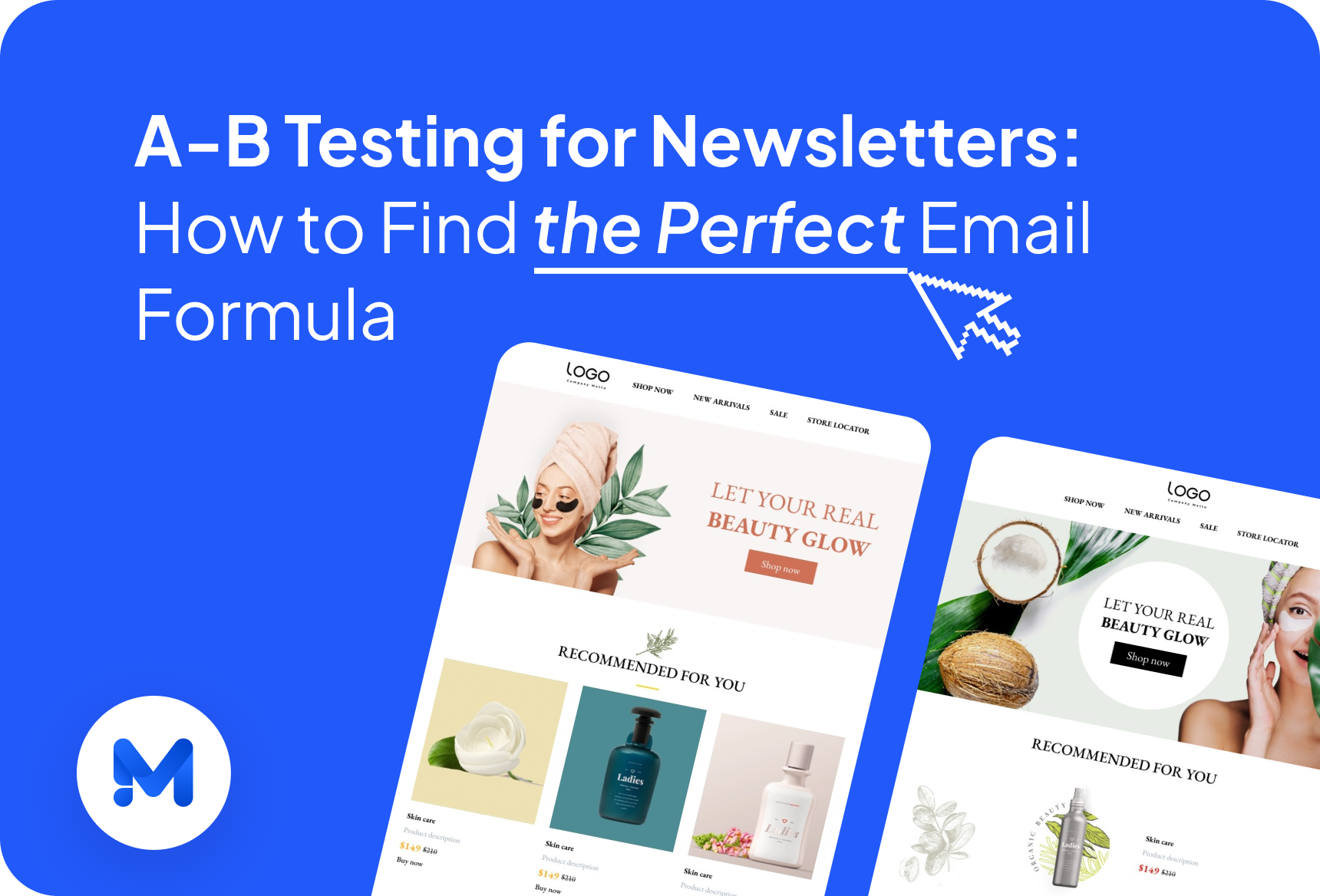
Let’s demystify the jargon. At its core, email A/B testing is a beautifully simple concept. You create two different versions of your email (Version A and Version B), send each version to a small, randomized portion of your audience, and see which one performs better based on a specific goal. The winning version is then automatically sent to the rest of your subscribers.
Think of it as a friendly competition where your audience gets to be the judge. Version A is your control—the email you would have sent anyway. Version B is your challenger, where you’ve changed one single element to see if it makes a difference.
This is a complete game-changer for any marketer. Why? Because it moves you from making assumptions to making data-driven decisions. The entire practice of A/B testing email marketing is about listening to your audience, not with surveys or polls, but by observing their actual behavior. This simple process allows you to:
- Increase open rates: discover the subject lines that truly capture attention in a crowded inbox.
- Boost click-through rates: identify the calls to action, images, and copy that compel subscribers to act.
- Reduce unsubscribes: deliver more relevant and engaging content that keeps your audience happy.
- Drive more conversions: ultimately, turn more subscribers into customers, clients, or loyal followers.

What to A/B test in your newsletter for maximum impact
Before you jump in, there is one golden rule you must follow: only test one variable at a time. If you change the subject line and the main call-to-action button in your B version, you’ll have no idea which change was responsible for the lift (or dip) in performance. By isolating a single variable, you gain a clear, actionable insight you can use in the future.
So, where do you start? Here are the most impactful elements to test.
The first hurdle: winning the inbox with subject line testing
Your subject line is the gatekeeper of your entire newsletter. It doesn’t matter how brilliant your content is if nobody opens the email in the first place. This is arguably the most critical and effective element to test.
Before you even write, you can use an email subject line tester tool to get some initial feedback on length and word choice, but nothing beats a real-world experiment with your own audience. Here are some powerful ideas for your next test email subject line:
- Length: pit a short, punchy subject line (e.g., “Your marketing questions, answered”) against a longer, more descriptive one (e.g., “This week: We answer your top 5 Questions on SEO and content strategy”).
- Personalization: test using the subscriber’s first name in the subject line versus a more general greeting.
- Tone & emotion: does a straightforward subject line (“New Guide to A/B Testing”) outperform one that creates urgency (“Don’t Make These A/B Testing Mistakes”)?
- Questions vs. statements: compare “Are you getting the most from your emails?” with “How to get more from your emails.”
- Emojis: test a subject line with a relevant emoji against one without. This can be highly dependent on your brand and audience.
Mastering A/B testing email subject lines is the fastest way to get more eyes on your content.
▶️Ready to build your master plan? Now that you know how to optimize your individual newsletters, the next step is to fit A/B testing into a complete, goal-driven plan. Read our full guide to building an effective email marketing strategy.
Beyond the open: what else should you be testing?
Once you’ve improved your open rates, it’s time to optimize what happens inside the email.
- The call to action (CTA). This is a huge one. Test the button text (“Get Your Free Guide” vs. “Download Now”), the button color (a bright, contrasting color vs. a more on-brand one), and its placement (at the top of the email vs. the bottom).
- Email copy and tone. Experiment with your writing style. Does a conversational, friendly tone resonate more than a formal, professional one? Test a long-form, story-driven email against a concise, scannable version with bullet points.
- Visuals. Does a bold hero image at the top increase engagement, or does a simpler, text-focused email lead to more clicks? Test a static image against an animated GIF.
- The sender name. This is a surprisingly powerful variable. Does an email from “Jessica at theMarketer” feel more personal and perform better than one from “theMarketer.com Team”?
- Send time and day. The age-old question. Don’t rely on industry benchmarks. Test sending your newsletter on a Tuesday at 10 AM versus a Thursday at 2 PM to discover when your specific audience is most likely to engage.

Your first mission: how to run an A/B test in 5 simple steps
Ready to launch your first test? Most modern email service providers have made this incredibly easy. Here’s a simple, step-by-step framework to follow.
- Choose your variable. Don’t try to test everything at once. Pick one element from the list above. For your first test, the subject line is always a great choice.
- Create your A and B versions. Write your two variations. For a subject line test, this means writing two different subject lines while keeping the email content, sender name, and preheader text completely identical.
- Select your test group. Your email platform will allow you to send the test to a small, random percentage of your total list. A common practice is to use 20% of your list for the test (10% receives Version A, and 10% receives Version B).
- Define what “Winning” looks like. You need to tell your email platform how to determine the winner. If you’re testing a subject line, your winning metric will be the open rate. If you’re testing a CTA button, it will be the click-through rate.
- Launch the test and analyze the outcome. Schedule your campaign. The platform will send the two versions to your test group, wait for a predetermined amount of time (usually a few hours) to gather data, identify the winner, and then automatically send that winning version to the remaining 80% of your list.
The story in the data: understanding your A/B test results
The test is done, and Version B won with a 15% higher open rate. Success! But the real victory isn’t just in this one campaign; it’s in the insight you’ve gained for the future.
- Look for statistical significance. This is a fancy term for ensuring your result is trustworthy and not just a random fluke. Most email platforms will tell you if the results are statistically significant, often by showing a “confidence” percentage. You want this to be 95% or higher to be certain the winning version is a true winner.
- Become a data storyteller. This is where you separate the pros from the amateurs. Keep a simple log of your tests in a spreadsheet. Note the date, what you tested, your hypothesis, the results, and what you learned. Over time, this document will tell you an incredibly detailed story about what your audience truly loves.
- From one test to a winning strategy. The learnings from one test should fuel the hypothesis for the next. If you discovered that a question-based subject line won, your next test could be a short question versus a long question. This creates a powerful cycle of continuous improvement, where every email you send is smarter than the last.
By embracing email A/B testing, you’re making a fundamental shift from an artist hoping their work is appreciated to a scientist who knows how to engineer a masterpiece. You are no longer guessing. You are building a repeatable formula for success, one test at a time.
You now have the framework to decode what makes your audience tick. You know that email A/B testing is the key, and that focusing on elements like your subject line and call to action can fundamentally transform your results.
So here’s your challenge: for your very next newsletter, just pick one thing. A simple subject line test. It’s the first step on a journey from guesswork to greatness.
Photo source: Freepik.com
(FAQ) Frequently asked questions on newsletter testing
How long should I wait for A/B test results?
Most platforms default to a test duration of 4 hours, which is usually sufficient to capture the majority of initial engagement. For less time-sensitive newsletters, you could extend this, but 4-6 hours is a solid benchmark.
What if my A/B test results are inconclusive?
If there’s no statistically significant winner, it simply means the variable you tested didn’t have a strong impact on your audience’s behavior. That’s a lesson in itself! Revert to your original version (the control) and plan to test a more dramatic or different element next time.
How often should I be A/B testing my newsletters?
There’s no magic number. A good rule of thumb is to test as often as you have a strong, clear hypothesis. Don’t test just for the sake of it. Instead, focus on consistent, purposeful testing to steadily build your knowledge base and improve your performance over time.